




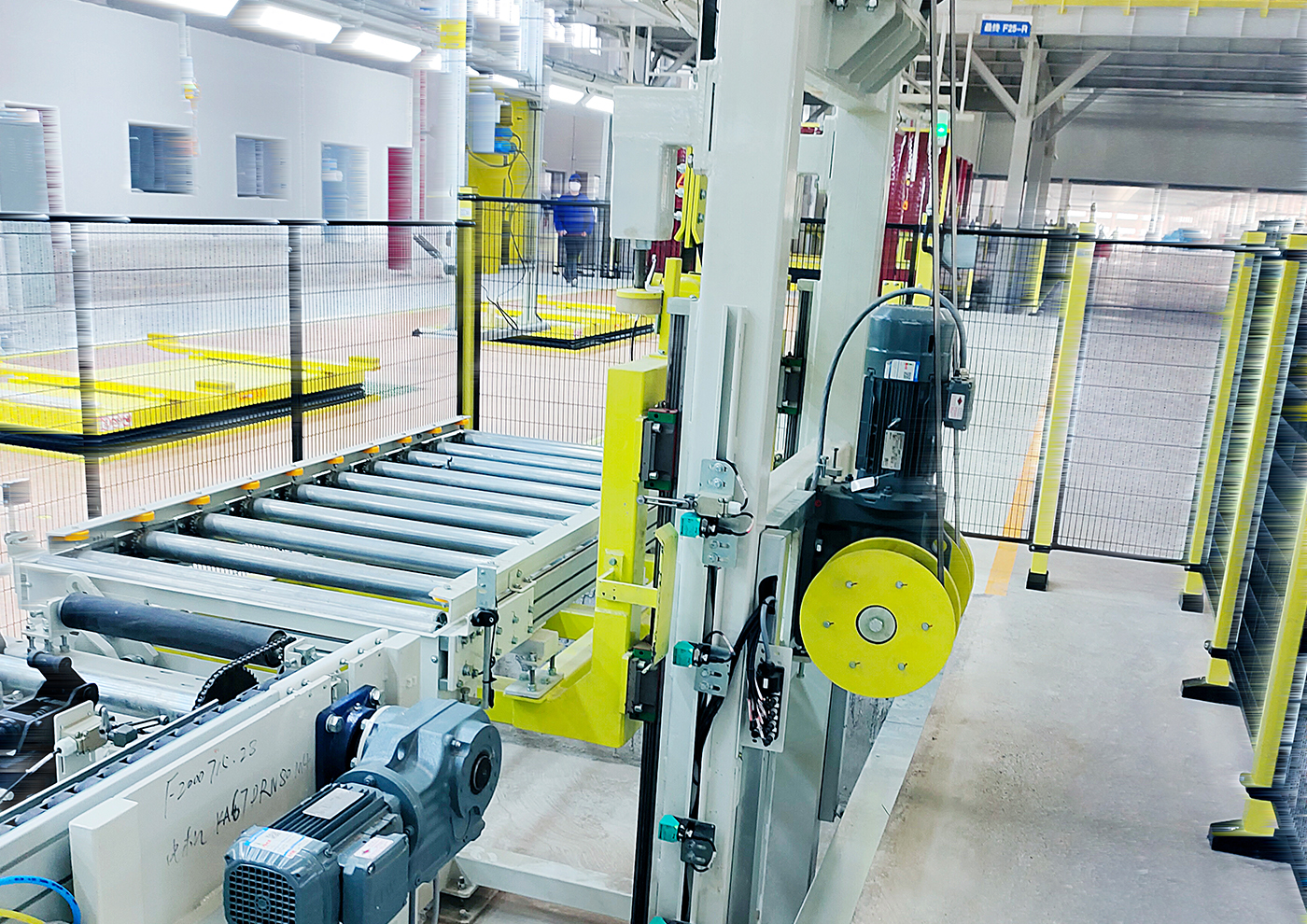

Elevator
The lift primarily consists of a vertical column, lifting drive unit, counterweight, lifting frame, hoisting mechanism, maintenance platform, stabilizing auxiliary mechanism, and control system. It is widely used in automated conveyor production lines across industries such as automotive, steel, construction machinery, light industry, and home appliances.
A lift is a mechanical device for vertical material transport. When integrated with other conveying systems, it enables material lifting and handling functions, serving as an intelligent aerial conveying solution capable of meeting diverse production cycle requirements.

| Product Features | |
|---|---|
|
The lift columns are constructed using square tubing or H-shaped steel sections. Depending on load requirements, single-column, double-column, and four-column lift systems are available. Material elevation is achieved by raising the lifting frame via motors on the lifting drive unit, while counterweights reduce drive power consumption. Both the lifting frame and counterweights are equipped with travel guide wheels, enabling smooth movement along the columns without jamming. The lifting mechanism connects the lifting frame and counterweight via chains or lifting belts. Since the lifting frame can integrate with roller beds, roller conveyors, sliding platforms, or various conveyor tracks, it accommodates diverse process requirements, enabling the lifting and handling of multiple load types. |
|
|
Performance Metrics |
Parameter |
|
Maximum Load |
≤1000KG |
|
Structure Type |
Belt Elevator |
|
Lifting Mechanism |
Ma Brand Elevator Belt |
|
Lifting Speed |
≤15m/min |
|
Lifting Acceleration/Deceleration |
≤0.5m/s² |
|
Lifting Travel |
<5m |
|
Noise |
≤55dB |
|
Operating Rate |
≥99% |
| Power Supply Method | Conductor Rail |
| Control Method | Wired/Wireless |